Your day is full of work that isn’t your work.
We build AI systems fitted to how your business already runs — starting with the question most contractors can’t answer: which of your jobs actually made money?
Free · 2 minutes · you keep the findings report either way
On the 3rd, this arrives. You don’t log in.
No new system, no new habit, nothing to learn. A message lands with the month in it — and the one job that lost you money, named.
Every month, without you asking
Your invoices come to us the way they already leave your office — an export, a folder of PDFs, or straight from your accounting system. We do the work. You read one message.
- Two honest numbers. What you billed, and what you’ve actually kept so far. Never one blended figure that flatters the month.
- Any job that has gone underwater, named — with where the money went.
- The sheets attached, if you want to check us. Most months you won’t.
A person reads every report before it sends. That is slower than fully automatic, and it is the reason the numbers can be trusted.
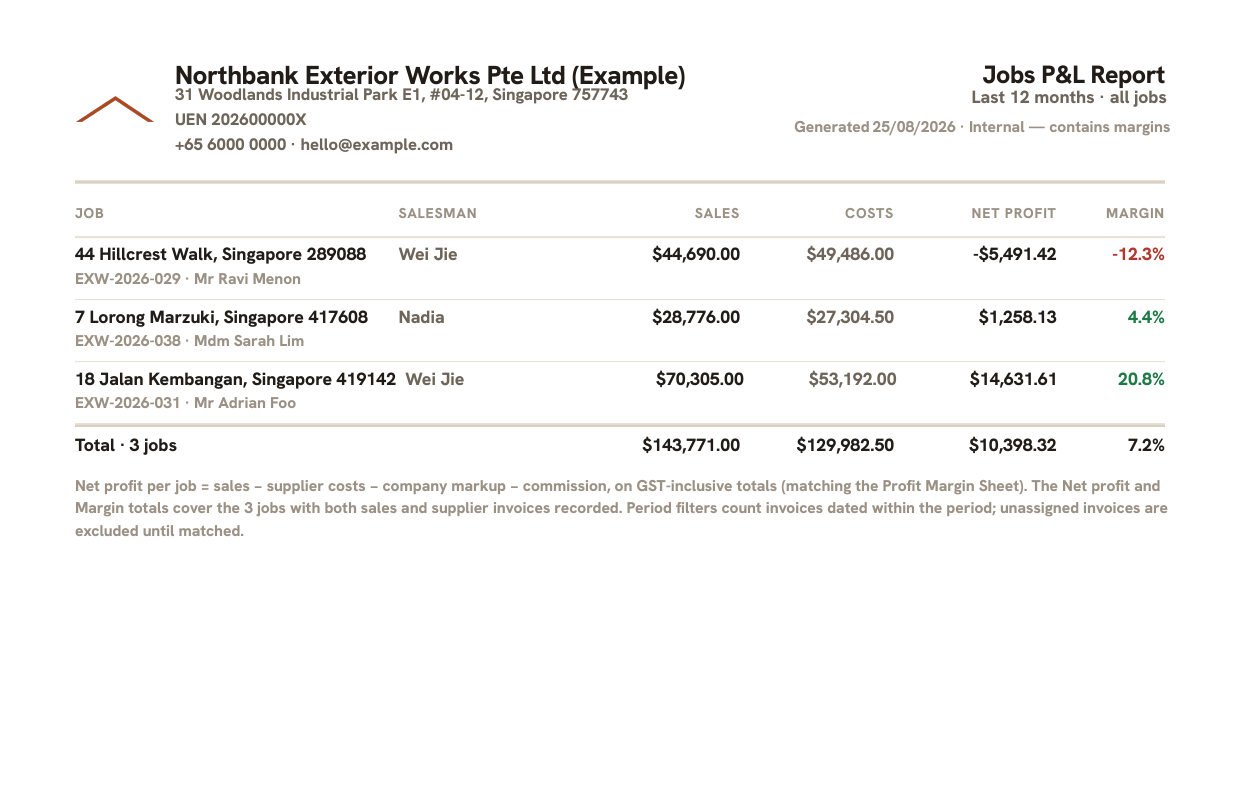
44 Hillcrest Walk is underwater — $5,491.42 down. $7,521.00 of supplier bills landed after you invoiced it out.
march-profit-sheets.pdfEvery job you ran, ranked by what it made.
Worst first — because the job that lost money shouldn’t be something you have to go and find.
Then the working, job by job
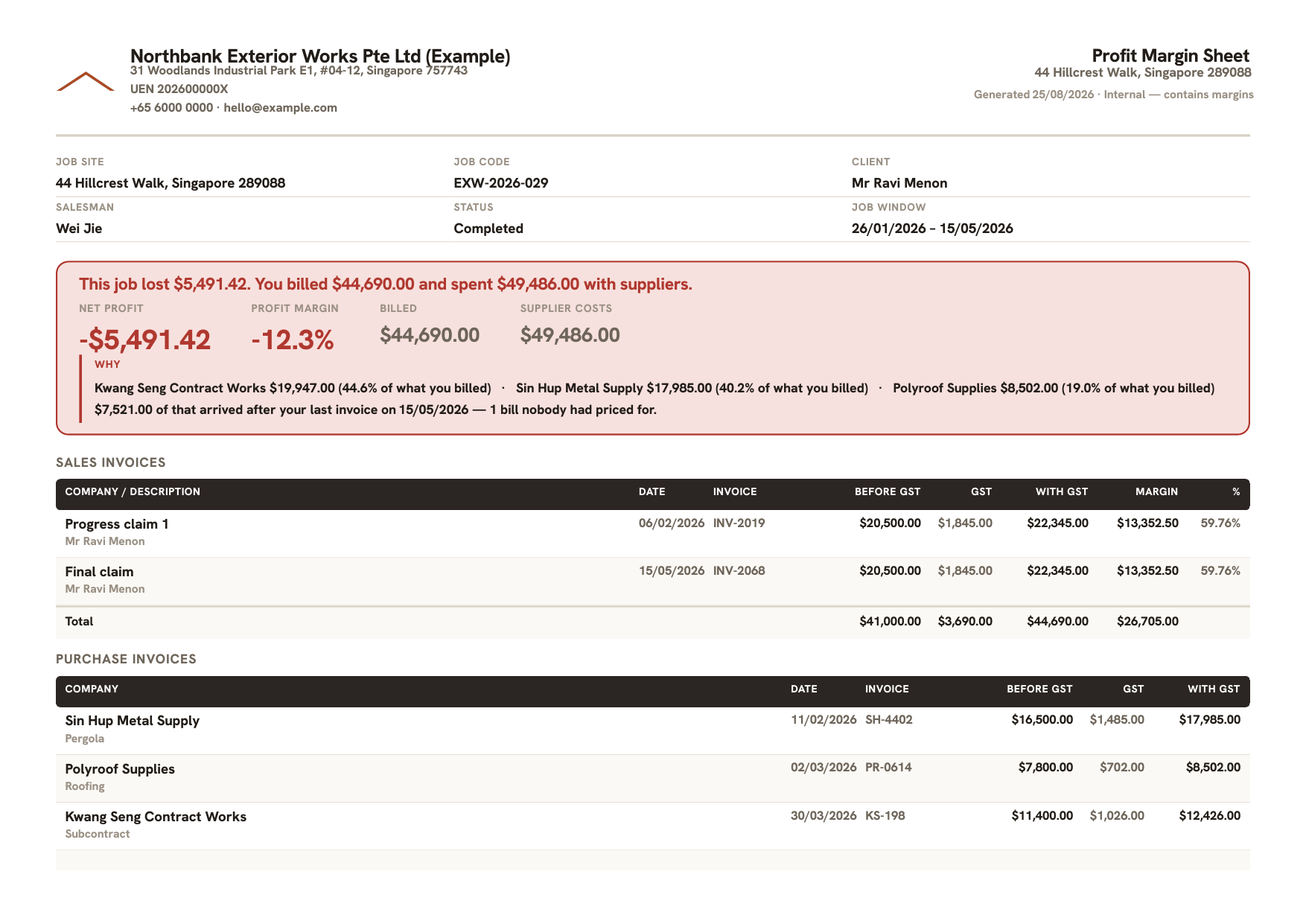
Behind the summary sits one sheet per job: what you billed, what it cost, and the difference — laid out the way you already write it down, in the words your trade already uses.
- It says what happened in a sentence before it shows you a single table.
- A losing job looks like one from across the room.
- Every figure re-checks against the invoices printed underneath it. Bring a calculator.
The screen is there when you want it.
Most owners never ask for it, and that’s fine — the month arrives either way. But when you want to look between reports, it’s the same numbers, on your own login.
The look back
Send last year’s invoices. In two weeks you’ll know which jobs made money and which didn’t. Check five of them by hand before you pay us.
Every month
The same answer, arriving on the same day, without you doing anything. Cancel whenever you like.
Your own login
Search any invoice, build a sheet, export it. The upgrade — not the starting point, and never the thing you have to learn first.
This isn’t a software upgrade. It’s a generational shift.
AI will be standard in your industry sooner than it looks — and your competitors will adopt it either way. Don’t be the one left behind. The businesses that move first set the pace: fast beats slow, not big beats small.
Your team, more valuable
AI doesn’t replace your people — it takes the repetitive work off them. The judgment, the relationships, the craft: that stays human, and finally gets room.
Revenue up, not just costs down
Saving hours is the start. The bigger prize is growth — personal service at scale, faster quotes, customers who never slip through the cracks.
We look first. You decide after.
The audit
A week alongside your team, finding where the hours leak.
Your report
Plain language, honest — including “AI isn’t the answer here” when it’s true.
The plan
Fixed scope, fixed price, what changes and by how much.
Build & fit
Your team tries it while we shape it. You own what we build.
Every business runs differently. That’s the point.
Tell us what eats your week. Two minutes, free, and the findings report is yours to keep.